Why Can’t You Stop Scrolling? The Psychology Behind Endless Feeds

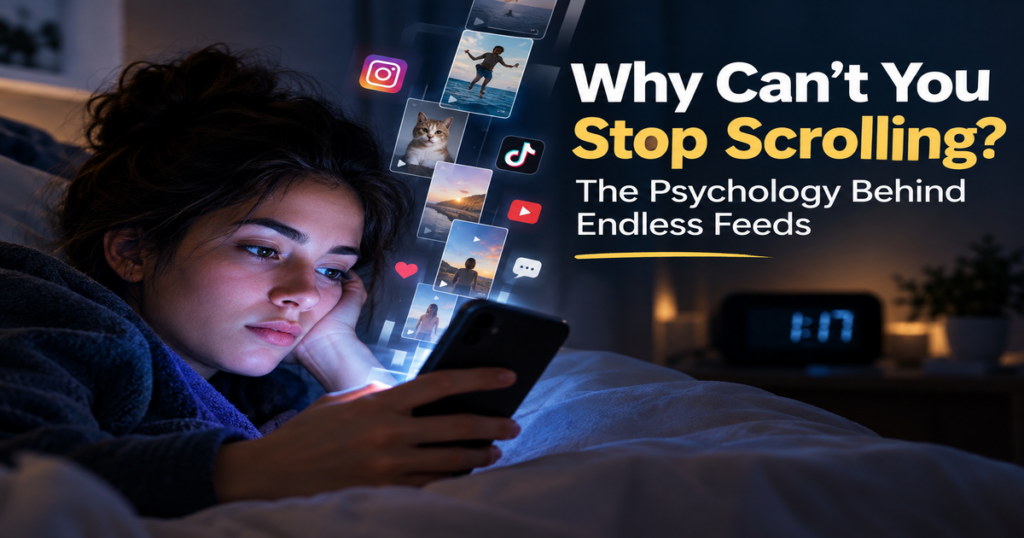
You open Instagram for five minutes.
Or YouTube Shorts.
Or Facebook.
You tell yourself:
“Just one more video.”
One video becomes five. Five becomes twenty. Then you suddenly look at the clock.
Forty-seven minutes have disappeared.
And the strange part is that you weren’t even enjoying all of it.
Maybe you were bored. Maybe you were tired. Maybe you were stressed. Perhaps you were avoiding work, trying to fall asleep, or simply looking for something interesting.
Yet your thumb kept moving.
So, why can’t you stop scrolling?
Is it a lack of self-control? Is social media addictive? Is your brain constantly looking for dopamine? Or is something more complicated happening?
The answer is more interesting than simply saying, “You have no willpower.”
Why Is Scrolling So Difficult to Stop?
Scrolling is difficult to stop because social-media feeds combine several powerful psychological processes:
- Constant novelty
- Unpredictable rewards
- Very little effort
- Habit formation
- Social feedback
- Personalized content
- Boredom and emotional escape
- No clear stopping point
Traditional activities usually have a natural ending.
A movie finishes.
A book has a final page.
A television programme ends.
But an infinite social-media feed doesn’t have a natural ending.
There is always another video.
Another post.
Another story.
Another notification.
Your brain therefore never receives a clear signal saying:
“You’re finished.”
And that simple design feature can make stopping surprisingly difficult.
There Is Always One More Video
Imagine someone gives you 100 short videos and asks you to watch as many as you want.
You might watch five.
You might watch ten.
Eventually, you may stop.
Now imagine that after every video, another one immediately appears.
You don’t have to choose what comes next.
You simply swipe.
And then another video appears.
And another.
This creates what is known as an infinite scroll.
Instead of asking yourself:
“Do I want to spend another hour on social media?”
you only have to make a much smaller decision:
“Do I want to watch this next video?”
That decision is extremely easy to repeat.
Before you know it, you have made the same tiny decision dozens or hundreds of times.
Your Brain Is Waiting for the Next Interesting Thing
One of the most powerful features of short-form content is novelty.
You never know exactly what the next swipe will reveal.
It could be:
- Something funny
- Something useful
- Something surprising
- Something emotionally satisfying
- Something controversial
- Something relatable
- Something completely unexpected
Most videos may not be particularly memorable.
But occasionally, you encounter something that really grabs your attention.
That unpredictability matters.
You don’t need to believe that the next video will definitely be amazing.
You only need to think:
“Maybe the next one will be.”
So you swipe again.
Research on problematic short-video use has found that different motivations are associated with excessive use, with escapism being particularly important. [1]
This helps explain why endless scrolling can become difficult to interrupt.
Why “Just Stop Scrolling” Doesn’t Always Work
People often treat excessive scrolling as a simple problem of willpower.
But many behaviours become automatic through repetition.
Think about what happens when you hear a notification.
You probably don’t consciously think:
“I shall now initiate a smartphone-checking behaviour.”
You simply pick up the phone.
Over time, particular situations can become associated with particular behaviours.
Bored → Phone
Waiting → Phone
Stressed → Phone
Eating → Phone
Bedtime → Phone
Difficult task → Phone
The situation becomes a cue for the behaviour.
Eventually, you may reach for your phone before you consciously decide that you want to use it.
This is one reason environmental changes can sometimes be more effective than repeatedly telling yourself to “have more self-control.”
Are You Scrolling Because You’re Bored?
Here’s an interesting question:
Do you always scroll because you’re enjoying yourself?
Not necessarily.
Sometimes we scroll because we don’t want to experience what we are feeling when we’re not scrolling.
It might be:
- Boredom
- Loneliness
- Stress
- Anxiety
- Mental fatigue
- Frustration
- An uncomfortable thought
- A difficult task
Short-form content provides an extremely easy way to occupy your mind.
You don’t have to decide what to watch.
You don’t have to put in much effort.
You simply swipe.
For some people, scrolling therefore becomes less about entertainment and more about escape.
Research supports this idea. A 2024 meta-analysis examining motivations behind problematic short-video use found that escapism was particularly strongly associated with problematic use. [1]
So sometimes the better question isn’t:
“Why am I addicted to my phone?”
It may be:
“What am I trying not to feel when I reach for my phone?”
That question can be much more revealing.
Scrolling Is Extremely Easy
Now compare two activities.
Reading a book
You need to:
- Find the book
- Open it
- Concentrate
- Follow the content
- Maintain attention
Scrolling
You:
- Unlock your phone
- Open an app
- Swipe
The second activity requires almost no effort.
When you’re mentally tired, low-effort stimulation can become especially attractive.
This creates an important psychological difference:
Many things that are good for us require effort.
Exercise requires effort.
Studying requires effort.
Reading requires sustained attention.
Having a difficult conversation requires emotional effort.
Scrolling requires very little.
That doesn’t mean scrolling is inherently bad.
It means that when your mental resources are low, scrolling is an extremely easy behaviour to choose.
Does Scrolling Release Dopamine?
You have probably heard statements like:
“Social media gives you a dopamine hit.”
Or:
“Your phone is making you addicted to dopamine.”
There is some truth behind the idea that reward-related brain systems are involved in motivating behaviour, but the popular explanation is far too simplistic.
Dopamine is not simply the brain’s “pleasure chemical.”
It is involved in several processes related to motivation, learning, reward prediction and reinforcement.
The important point for scrolling is that social-media platforms provide a continuous stream of potentially rewarding experiences.
You don’t know exactly what the next video will contain.
Sometimes it is boring.
Sometimes it is funny.
Sometimes it is fascinating.
Sometimes it is emotionally powerful.
That uncertainty can encourage continued engagement.
So rather than thinking:
“I’m addicted to dopamine.”
A more useful psychological explanation is:
“My behaviour is being reinforced by a continuous stream of unpredictable and personalized rewards.”
That is a much more accurate way to understand the problem.
Why Do You Scroll When You’re Already Tired?
This is one of the strangest parts of smartphone use.
You’re exhausted.
You know you should sleep.
Yet you keep scrolling.
Why?
Because scrolling can become a form of low-effort emotional regulation.
You may not have enough mental energy for something demanding.
But you may still want stimulation.
So you choose something that requires almost no effort.
One more video.
One more post.
One more notification.
Then another.
Suddenly it is 1:17 a.m.
This is one reason late-night scrolling can become a habit even when you genuinely want to sleep.
Is Scrolling Destroying Your Attention Span?
This is where we need to be careful.
You may have seen headlines claiming that Reels and TikTok are “destroying your brain” or permanently damaging your attention span.
The scientific evidence is more complicated.
A 2025 systematic review and meta-analysis published in Psychological Bulletin examined 71 studies involving 98,299 participants. Greater short-form-video use was associated with poorer cognitive outcomes overall, with attention and inhibitory control showing particularly notable associations. [2]
However, most of this type of research is correlational.
That means we can say:
People who use short-form videos more often tend to show certain cognitive differences.
But we cannot automatically say:
Short-form videos caused those cognitive differences.
There may be other explanations.
For example, people who already struggle with attention or self-control may also be more likely to engage heavily with short-form content.
This distinction is important if we want to understand the psychology rather than simply create another scary internet headline.
Routine Scrolling Is Not the Same as Problematic Scrolling
Another important distinction is that using social media frequently does not automatically mean you are addicted.
Someone might spend an hour on Instagram every day without experiencing significant problems.
Another person might spend less time online but repeatedly lose control over their use.
So the more useful questions are:
- Can you control when you use social media?
- Do you regularly use it longer than you intended?
- Does scrolling interfere with sleep?
- Does it interfere with work or study?
- Do you neglect important responsibilities?
- Have you tried to reduce your use but repeatedly failed?
- Do you use scrolling mainly to escape uncomfortable emotions?
- Is your social-media use causing significant problems in your life?
The pattern, control and consequences matter more than one simple number of minutes.
Recent research has also increasingly distinguished problematic short-form-video use from ordinary use, finding stronger associations between problematic use and adverse mental-health outcomes. [3]
Why Social Media Can Make You Feel Worse
Sometimes you aren’t simply watching other people’s content.
You’re comparing your life with theirs.
Someone is travelling.
Someone got married.
Someone bought a house.
Someone got promoted.
Someone lost weight.
Someone’s child is doing exceptionally well.
Someone looks incredibly happy.
Someone seems to have figured life out.
You know that social media shows a selective version of reality.
But knowing this intellectually doesn’t always prevent emotional comparison.
Repeated exposure to carefully selected images and stories can create opportunities for social comparison.
Research has linked problematic social-media use with psychological factors including negative social comparison and impulsivity. [4]
And suddenly your scrolling isn’t just:
“I’m watching videos.”
It becomes:
“How is everyone else doing compared with me?”
That can keep you engaged while simultaneously making you feel inadequate.
Why Do We Scroll When We Are Stressed?
Stress creates another interesting cycle.
You feel stressed.
You open your phone to relax.
You scroll for 30 minutes.
You temporarily stop thinking about the problem.
Then you put the phone down.
The original problem is still there.
Now you have less time to deal with it.
You feel more stressed.
So you scroll again.
This creates a simple loop:
Stress → Scrolling → Temporary relief → Problem remains → More stress → More scrolling
Of course, scrolling does not always create this cycle.
But when it becomes someone’s primary way of escaping uncomfortable emotions, it can become increasingly difficult to control.
The Most Important Question: What Are You Looking For?
The next time you notice yourself automatically opening Instagram, YouTube Shorts or another social-media app, don’t immediately ask:
“How do I stop?”
Ask:
“What am I looking for right now?”
Maybe you’re looking for:
Stimulation
“I’m bored.”
Escape
“I don’t want to think about this.”
Connection
“I feel lonely.”
Reassurance
“I want to know whether someone replied.”
Novelty
“I need something interesting.”
Relaxation
“I’m mentally exhausted.”
Once you understand what the behaviour is doing for you, changing it becomes much easier.
How to Stop Scrolling So Much
You don’t necessarily need to delete every social-media app.
Instead, try changing the conditions around your behaviour.
1. Create a specific stopping point
Don’t tell yourself:
“I’ll use Instagram less.”
Make the rule specific:
“I’ll scroll for 20 minutes, then stop.”
Specific behavioural limits are easier to follow than vague intentions.
2. Remove unnecessary notifications
Every notification can become a cue to check your phone.
Turn off notifications that aren’t genuinely important.
The goal isn’t to make your phone useless.
It’s to reduce unnecessary interruptions.
3. Make the app slightly harder to access
Move frequently used social-media apps away from your home screen.
Log out if necessary.
Use app limits if they work for you.
These small barriers can interrupt automatic behaviour.
Sometimes adding friction is easier than relying on willpower.
4. Don’t keep your phone beside your pillow
If your phone is next to your head, scrolling requires almost no effort.
Put it somewhere that requires you to physically get up.
A small amount of friction can make a surprisingly large difference to an automatic habit.
5. Identify your scrolling triggers
For three days, simply observe yourself.
When do you automatically reach for your phone?
Is it:
- When you’re bored?
- When you’re stressed?
- During difficult work?
- Before sleeping?
- After waking?
- While eating?
- When you’re alone?
- After an argument?
You may discover that the problem isn’t simply:
“I use my phone too much.”
It may actually be:
“I use my phone whenever I feel uncomfortable.”
That’s a much more useful insight.
6. Replace the function, not just the behaviour
If scrolling gives you stimulation, find another source of stimulation.
If it provides relaxation, find another way to relax.
If it gives you connection, contact someone.
If it helps you avoid difficult thoughts, develop healthier ways of dealing with those thoughts.
Simply taking away a behaviour without replacing its psychological function can make change difficult.
Try the 10-Second Pause
Here’s a very simple experiment.
The next time your hand automatically reaches for your phone:
Stop for 10 seconds.
Then ask yourself:
“What am I about to do—and why?”
That’s all.
You don’t have to delete Instagram.
You don’t have to stop using social media.
You don’t even have to put the phone down.
You’re simply creating a small gap between the urge and the action.
That gap creates an opportunity for conscious choice.
When Does Scrolling Become a Problem?
Scrolling becomes more concerning when you repeatedly lose control over it and it starts interfering with your daily life.
For example:
- You regularly stay awake much later than intended.
- Work or study is repeatedly disrupted.
- You neglect relationships or responsibilities.
- You repeatedly try to cut down but cannot.
- Scrolling becomes your main way of dealing with difficult emotions.
- You experience significant distress when you cannot access social media.
- Your social-media use is causing meaningful problems in your life.
The important question isn’t simply:
“How many hours are you on your phone?”
A better question is:
“What is your phone use doing to your life?”
Final Takeaway
You probably don’t keep scrolling because you’re lazy.
And frequent scrolling doesn’t automatically mean that your attention span is permanently damaged.
You’re interacting with a highly stimulating digital environment built around:
novelty + personalization + social feedback + continuous content.
Your own habits can then make the behaviour increasingly automatic.
Sometimes you are looking for entertainment.
Sometimes you’re escaping boredom.
Sometimes you’re avoiding stress.
Sometimes you’re looking for connection.
And sometimes you’re simply waiting for the next interesting thing.
So the solution isn’t necessarily to hate your phone.
It’s to understand your behaviour.
The next time you catch yourself saying:
“I’ll just watch one more…”
pause.
Ask yourself:
“One more what—and what am I actually looking for?”
That question may tell you more about your scrolling habit than another screen-time report ever could.
Frequently Asked Questions
Scrolling can become habitual because social-media feeds combine novelty, unpredictable rewards, low effort and continuous content. Particular situations such as boredom, stress or bedtime can also become cues for automatically checking your phone.
Short-form videos provide rapid novelty and require very little effort. Because you don’t know what the next video will contain, the possibility of finding something interesting can encourage continued scrolling.
Reward-related brain systems, including dopamine pathways, are involved in motivation and learning. However, describing social-media use simply as a “dopamine addiction” is an oversimplification. Scrolling is better understood through concepts such as reinforcement, novelty, habit formation and reward prediction.
Research has found associations between greater short-form-video use and poorer attention and inhibitory control. However, much of the evidence is correlational, so it does not establish that scrolling itself causes attention problems.
Keep your phone away from your bed, disable unnecessary notifications, create a fixed stopping time and identify what triggers your late-night scrolling. Replacing scrolling with another relaxing bedtime activity can also make the change easier.
There is no single number of minutes that automatically makes social-media use problematic. More important factors include loss of control, interference with sleep or responsibilities, repeated unsuccessful attempts to cut down and significant distress or impairment.
No. Social media can provide entertainment, information, communication and social connection. The concern arises when use becomes difficult to control or begins interfering with important areas of life.
References
- Chen, Y., Zhang, W., Zhong, N., Zhao, M., et al. (2024). Motivations behind problematic short video use: A three-level meta-analysis. Telematics and Informatics, 95, 102196.
- Nguyen, L., et al. (2025). Feeds, feelings, and focus: A systematic review and meta-analysis examining the cognitive and mental health correlates of short-form video use. Psychological Bulletin, 151(9), 1125–1146.
- Association Between Short-Form Video Use and Mental Health: Systematic Review and Meta-Analysis. (2026). Journal of Medical Internet Research, 28.
- Benucci, S. B., Rega, V., Boursier, V., Casale, S., & Fioravanti, G. (2025). Impulsivity and problematic social network sites use: A meta-analysis. Journal of Psychiatric Research, 188, 183–199.




Responses